Part 1The Domino
“So you want to see some,” my friend de Jakels had told me. “Very well. Get yourself a domino and a half-mask, a rather elegant domino of black satin; put on pumps and, for once, black silk stockings, and wait for me at your place on Tuesday. Around half past ten, I’ll come to fetch you.”
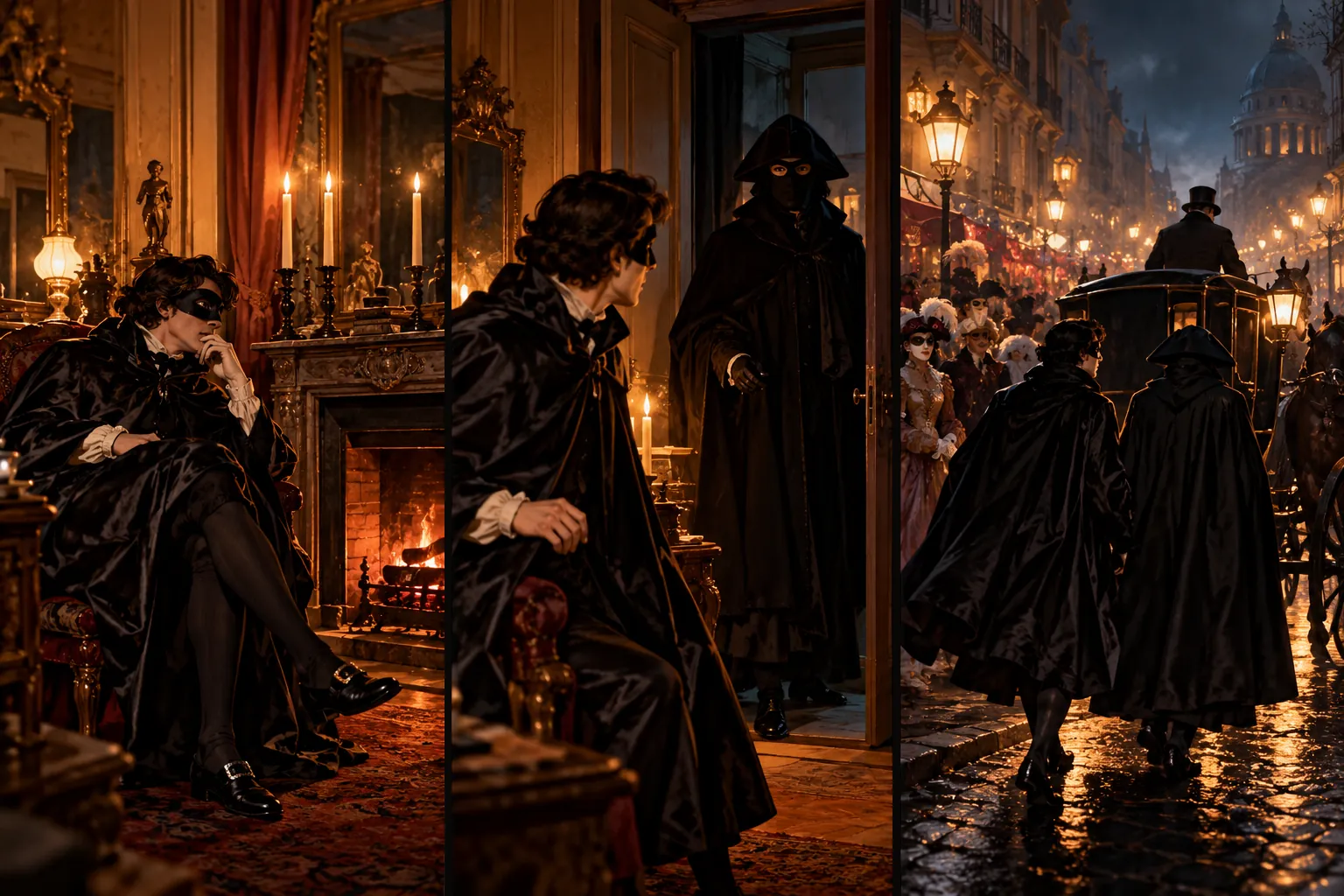
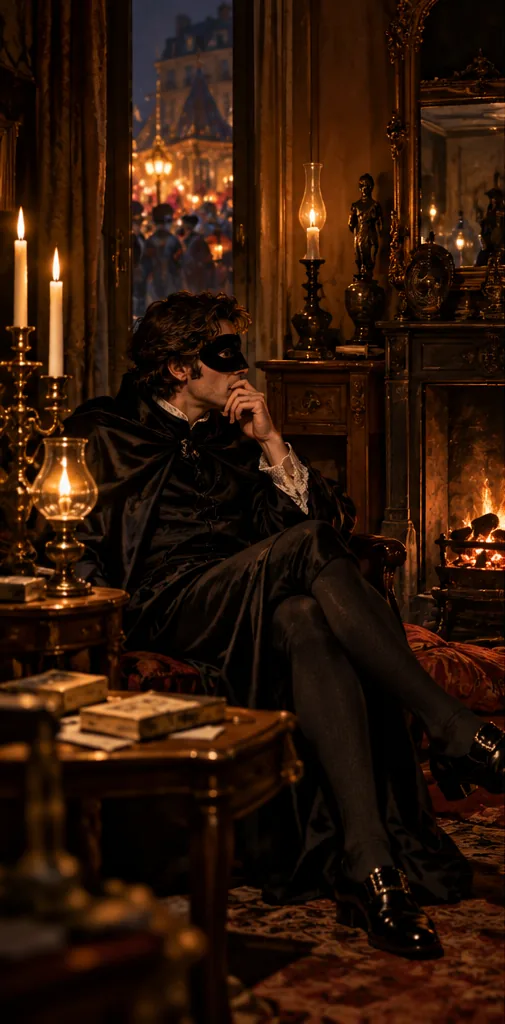
The following Tuesday, wrapped in the rustling folds of a long cape, a velvet mask with a satin beard fastened behind my ears, I was waiting for my friend de Jakels in my bachelor rooms on the rue Taitbout, warming at the embers of the fireplace my feet, bristling from the irritating touch of silk; outside, the blare of horns and the exasperated shouts of a Carnival night reached me, muffled, from the boulevard.
Rather strange, even disquieting in the long run, on reflection, was this solitary vigil of a masked figure sprawled in an armchair, in the half-light of this ground-floor room crowded with knickknacks and muffled in hangings, with, in the mirrors hung on the walls, the high flame of an oil lamp and the flickering of two long, very white candles, slender, almost funereal; and de Jakels did not come.
The cries of the masks bursting out in the distance made the hostility of the silence worse still; the two candles burned so straight that a nervousness finally took hold of me and, suddenly alarmed before these three lights, I rose to go and blow one out.
At that moment, one of the door curtains parted and de Jakels came in.
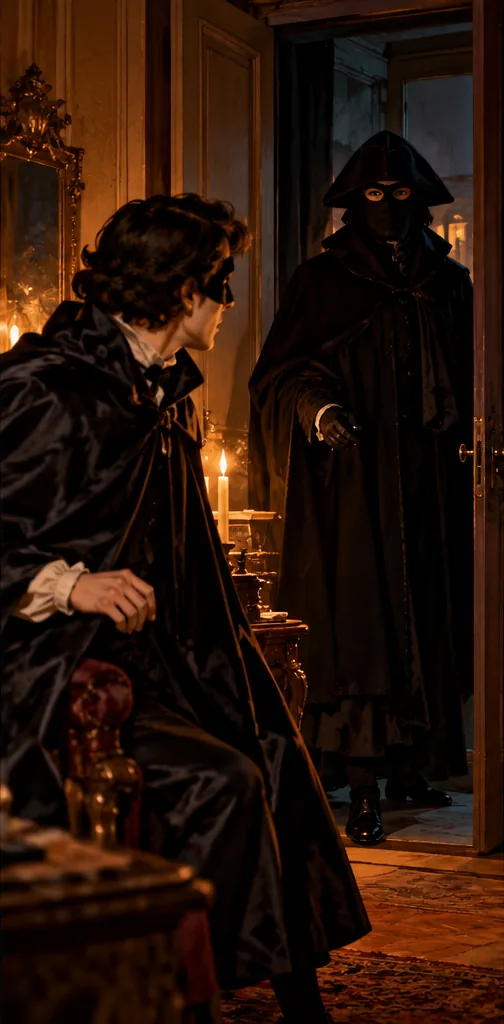
De Jakels? I had heard neither the bell nor the door. How had he got into my apartment? I have thought about it often since; in any case, de Jakels was there before me; de Jakels? That is to say, a long domino, a tall dark form, veiled and masked like me:
“Are you ready?” his voice asked, a voice I did not recognize. “My carriage is outside; we are going to leave.”
His carriage: I had heard it neither roll up nor stop in front of my windows. Into what nightmare, what shadow, what mystery had I begun to descend? “It’s your hood that is stopping up your ears; you’re not used to the mask,” de Jakels said aloud, having read my silence: so tonight he had every gift of divination, and, turning up my domino, he checked the fineness of my silk stockings and my thin shoes.
This gesture reassured me; it was indeed de Jakels, and no one else, who was speaking to me beneath that domino; anyone else would not have cared about the instruction de Jakels had given me a week before.
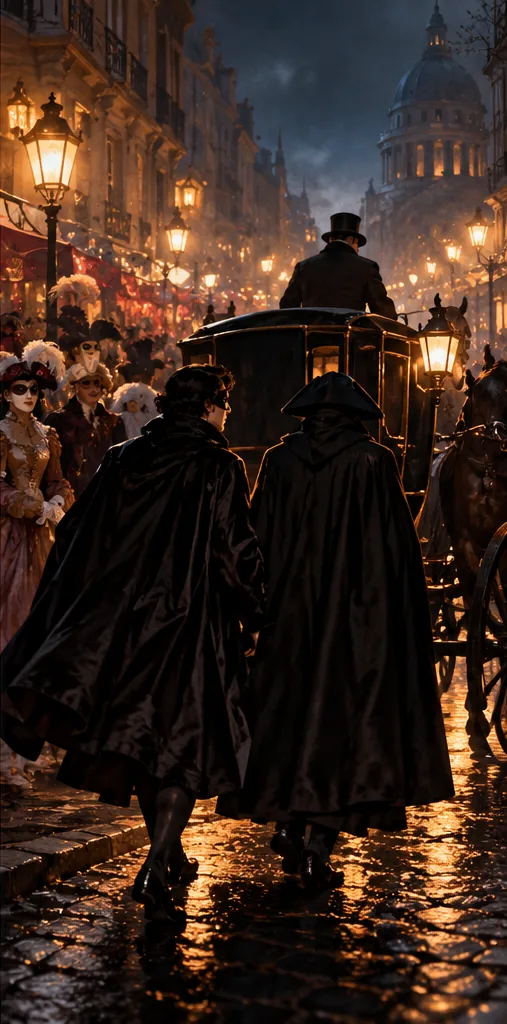
“Well, then, off we go,” the voice commanded, and in a rustle of silk and crumpled satin we plunged into the passage of the carriage gate, rather like, it seemed to me, two enormous bats, in the flapping of our capes suddenly raised above our dominos.
Where did this great wind come from? This breath of the unknown? The temperature of that Mardi Gras night was at once so damp and so soft.
Part 2The Silent Cab
Where were we rolling now, huddled in the shadow of this extraordinarily silent cab, whose wheels, no more than the horse’s hooves, raised any sound on the wooden paving of the streets and the macadam of the deserted avenues?
Where were we going along these unknown quays and embankments, barely lit here and there by the dim lantern of an ancient streetlamp? For a long time now we had lost sight of the fantastic silhouette of Notre-Dame outlined on the far side of the river against a leaden sky.
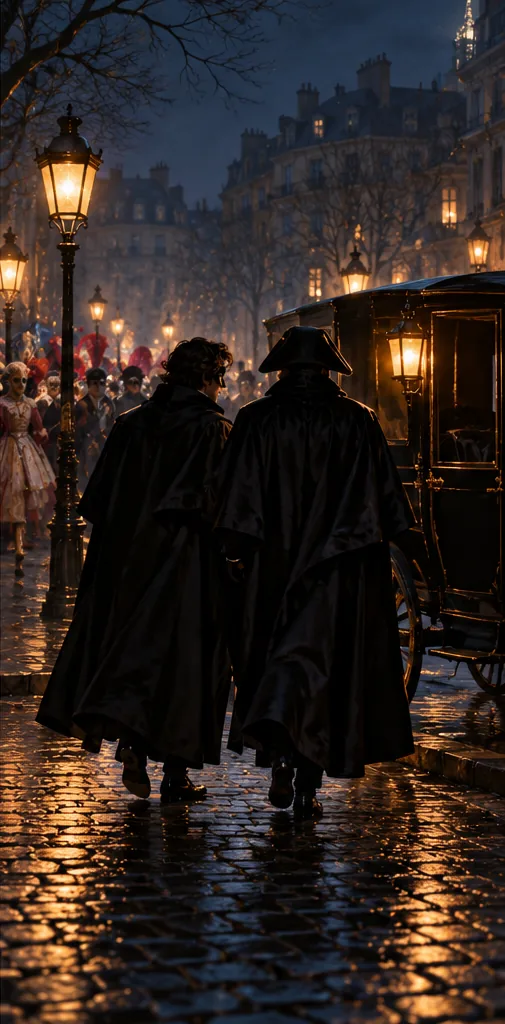
Quai Saint-Michel, quai de la Tournelle, even quai de Bercy: we were far from the avenue de l’Opéra, from the rue Drouot and the rue Le Peletier and the center of town. We were not even going to Bullier, where shameful vices hold their sessions and, escaping under the mask, whirl almost demonically and cynically avowed on the nights of Mardi Gras, and my companion said nothing.
Beside this taciturn, pale Seine, under the span of bridges ever fewer, along these quays planted with tall, thin trees whose branches spread like the fingers of the dead, an irrational fear seized me, a fear made worse by de Jakels’s inexplicable silence; I came to doubt his presence and to believe myself beside a stranger.
My companion’s hand had seized mine, and, although limp and without strength, held it in a vise that crushed my fingers… That hand of power and will nailed the words in my throat, and under its grip I felt every impulse to revolt melt and dissolve within me; we were now rolling outside the fortifications, along highways bordered by hedges and dreary wine merchants’ storefronts, taverns at the city gates long since closed; we sped beneath the moon, which had at last nicked a strip of clouds and seemed to spread over that equivocal suburban landscape a crackling sheet of mercury and salt; at that moment it seemed to me that the wheels of the cab, ceasing to be phantoms, were crying out in the gravel and stones of the road.
“This is it,” murmured my companion’s voice, “we have arrived, we can get out,” and as I stammered a timid: “Where are we?”-“Barrière d’Italie, outside the fortifications; we took the longest road, but the safest; we’ll go back by another tomorrow.” The horses stopped and de Jakels let go of me to open the door and hold out his hand to me.
Part 3The Tavern at the Toll Gate
A great, very tall room with whitewashed plaster walls, inner shutters tightly closed at the windows; along the whole length of the room, tables with tin cups held by chains and, at the far end, raised three steps, the zinc counter crowded with liquor and bottles with colored labels, the legendary wine merchants’ kind; above it, the gas hissing high and clear: the ordinary room, in short, of a tavern at the city gates, only larger and cleaner, whose business must be doing well. “Above all, not a word to anyone; speak to no one, and answer even less; they would see that you are not one of them, and we might have a bad quarter of an hour. As for me, they know me,” and de Jakels pushed me into the room.
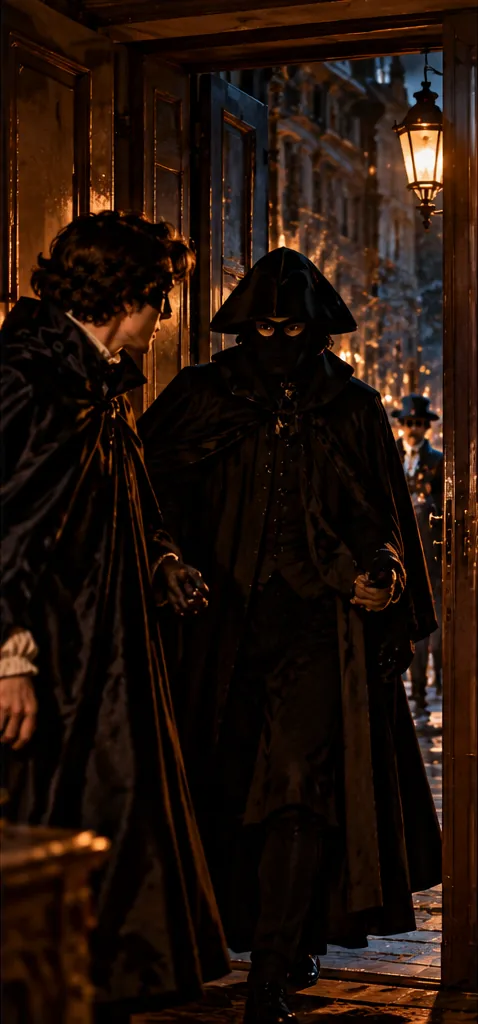
A few masks were drinking there, scattered about. At our entrance, the proprietor rose and heavily, dragging his feet, came toward us as if to bar our way. Without a word, de Jakels lifted the hem of our two dominos and showed him our feet in fine pumps! It was the Open Sesame, no doubt, of this strange establishment; the proprietor went heavily back to his counter, and I noticed, oddly, that he too was masked, but in a crude cardboard mask, burlesquely colored, imitating a human face.
The two waiters, two hairy colossi with shirtsleeves rolled up over wrestlers’ arms, moved about in silence, invisible, they too, beneath the same hideous mask.
The few costumed people drinking seated around the tables were masked in satin and velvet, except an enormous cuirassier in uniform, a sort of brute with a heavy jaw and a tawny mustache, seated beside two elegant dominos of mauve silk, and who drank with his face uncovered, his blue eyes already vague; none of the beings met there had a human face.
In a corner, two tall men in smocks and velvet caps, masked in black satin, aroused suspicion by their elegance; for their smocks were of pale blue silk and, from the bottoms of their too-new trousers, tapered the narrow toes of women, gloved in silk and shod in pumps; and, as if hypnotized, I would still be contemplating this spectacle if de Jakels had not drawn me to the back of the room, toward a glass door closed by a red curtain.
Entrance to the Ball, it was inscribed above this door in the flourished letters of an apprentice painter; a municipal guard was, moreover, standing watch beside it. That was at least a guarantee, but in passing, having brushed his hand, I realized it was made of wax, wax like his pink face bristling with false mustaches, and I had the horrible conviction that the only being whose presence could have reassured me in this place of mystery was a mere mannequin.
Part 4The Ball of the Hoods
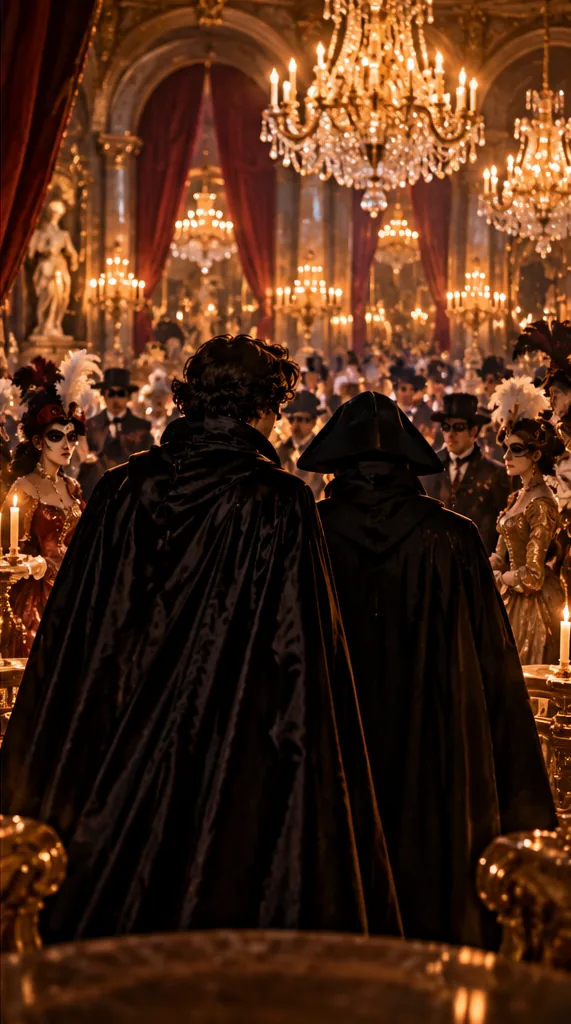
For how many hours had I been wandering alone among these silent masks, in this hangar vaulted like a church? And it was a church indeed, an abandoned, deconsecrated church, this vast hall with pointed windows, most of them half walled up between their little columns with scrollwork, daubed with a thick yellowish plaster in which the carved flowers of the capitals were sinking.
A strange ball, where no one danced and where there was no orchestra. De Jakels had disappeared; I was left alone in the midst of this unknown crowd. An old wrought-iron chandelier blazed high and clear, hanging from the vault, lighting dusty flagstones, some of which, blackened with inscriptions, perhaps covered tombs.
At the far end, in the place where the altar must certainly once have stood, mangers and hayracks ran at half height along the wall, and in the corners lay heaps of forgotten harnesses and halters; the ballroom was a stable.
Here and there great barbers’ mirrors framed in gilt paper sent back to one another the silent promenade of the masks; that is, they no longer sent it back, for all had now sat down, ranged motionless on both sides of the church, buried up to the shoulders in the old choir stalls.
They sat there mute, without a gesture, as if withdrawn into mystery beneath long cowls of silver cloth, a dull silver with a dead sheen; for there were no more dominos, nor blue silk smocks, nor Harlequins nor Columbines, nor grotesque costumes, but all these masks were alike, sheathed in the same green robe of a pallid green as if sulfured with gold, with long black sleeves, and all hooded in dark green with, in the emptiness of the hood, the two eyeholes of their silver cowl.
They looked like the chalky faces of lepers, and their black-gloved hands held up a long stem of black lily with pale green foliage, and their hoods, like Dante’s, were crowned with black lilies.
And all these cowls were silent in a spectral stillness and, above their funereal crowns, the pointed arch of the windows, cut out in light against the white moonlit sky, capped them like a bishop’s miter.
I felt my reason sinking into terror; the supernatural enveloped me! This rigidity, this silence of all these masked beings. Who were they? One more minute of uncertainty would be madness! I could bear it no longer and, with a hand clenched with anguish, having stepped toward one of the masks, I abruptly lifted its cowl.
Horror! There was nothing, nothing. My haggard eyes met only the hollow of the hood; the robe, the cape were empty. This being that lived was only shadow and void. Mad with terror, I tore the cowl from the mask seated in the next stall; the green velvet hood was empty, empty was the hood of the other masks seated along the walls. All had faces of shadow, all were void.
And the gas flared stronger, almost hissing in the high hall; through the broken panes of the pointed windows the moonlight blinded; then a horror seized me in the midst of all these hollow beings of vain appearances, a dreadful doubt gripped my heart before all these empty masks.
If I were like them, if I too had ceased to exist and if beneath my mask there was nothing, nothing but void! I rushed toward one of the mirrors. A dream-being stood there before me, hooded in dark green, masked in silver, crowned with black lilies.
Part 5The Mirror
And that mask was me, for I recognized my gesture in the hand lifting the cowl and, gaping with fright, I let out a great cry, for there was nothing beneath the mask of silvered cloth, nothing in the oval of the hood but the hollow of the fabric curved over the void; I was dead and I… “And you’ve been at the ether again,” scolded the voice of de Jakels in my ear.
“A singular idea for beguiling your boredom while you waited for me.” I lay stretched out in the middle of my room, my body slid onto the rug, my head resting on an armchair, and de Jakels, in evening dress beneath a monk’s robe, was giving feverish orders to my bewildered valet; on the mantel the two lit candles, burned down to their ends, were cracking their drip-pans and waking me…
It was time.